
S3 - Project Details
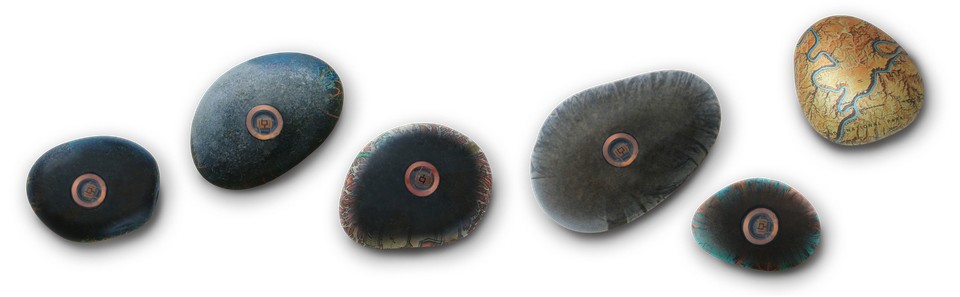
Turning over the stones
If you’re reading this, you’ve likely already expressed interest in the project - yay!
This page is a snapshot of where Stonemaps is right now — and where collaboration is most useful for our MVP of 50 stones in people's hands.
The three elements
Stonemaps is an integrated system made up of three key parts:
- The physical object, shaped by geological time, embellished with a map
- The digital layer, grounded in meaningful interaction
- The conversational intelligence, designed for relational conversation
Decisions in one layer ripple into the other layers.
The stone as an interface
Each Stonemap begins as a polished fragment of the planet and is wrapped in an abstraction of itself.
Each stone is:
- hydrographically imprinted with a high-resolution cartographic image
- drilled for processing and embedded with a QR code tag or NFC chip
- ceramic-coated to withstand repeated handling, gifting, and travel
The map is customizable by the end-user with the Stonemaps Composer
Prototyping the production workflow of hydrographic immersion:
The digital layer
Scanning a stone opens a geolocating mobile interface, implemented as a Progressive Web App (built with Svelte and Svelte Kit).
The interface:
- registers approximate location (with consent and intentional delay)
- opens a session with that stone’s Planetary Emissary and the private journal
Data collection is minimal and opt-in, only what serves project learning objectives.
The Planetary Emissary (PE)
Each stone is embedded with a conversational AI agent: a Planetary Emissary.
Emissaries share a common constitutional framework, but each expresses:
- distinct conversational tendencies
- particular curiosities and themes
- evolving memory shaped by prior encounters
The PE is designed to:
- resist extractive conversational patterns
- slow the pace of interaction
- invite reflection, journaling, and gifting to the network
Memory is cumulative but subtle. Past encounters influence tone and direction rather than being replayed or summarized. The aim is relational continuity across hands and time, not personalization in a commercial sense.
The PWA & platform foundation
The Stonemaps mobile experience is built as a Progressive Web App, with the backend implemented in Svelte and SvelteKit. The core system is functional and supports: stone identity, geolocation, media upload, chat, and memory.
What’s needed now is the front-end.
Specifically:
- UX/UI design tuned to slowness, clarity, and restraint
- a reframing of scope toward a tight MVP for the first 50 stones
- decisions about what not to include at this stage
The goal is a mobile experience that feels light, legible, and intentional—one that stays out of the way of the encounter rather than competing with it.
The Stonemaps Composer
The Stonemaps Composer is a browser-based tool for selecting maps for hydrographic imprinting.
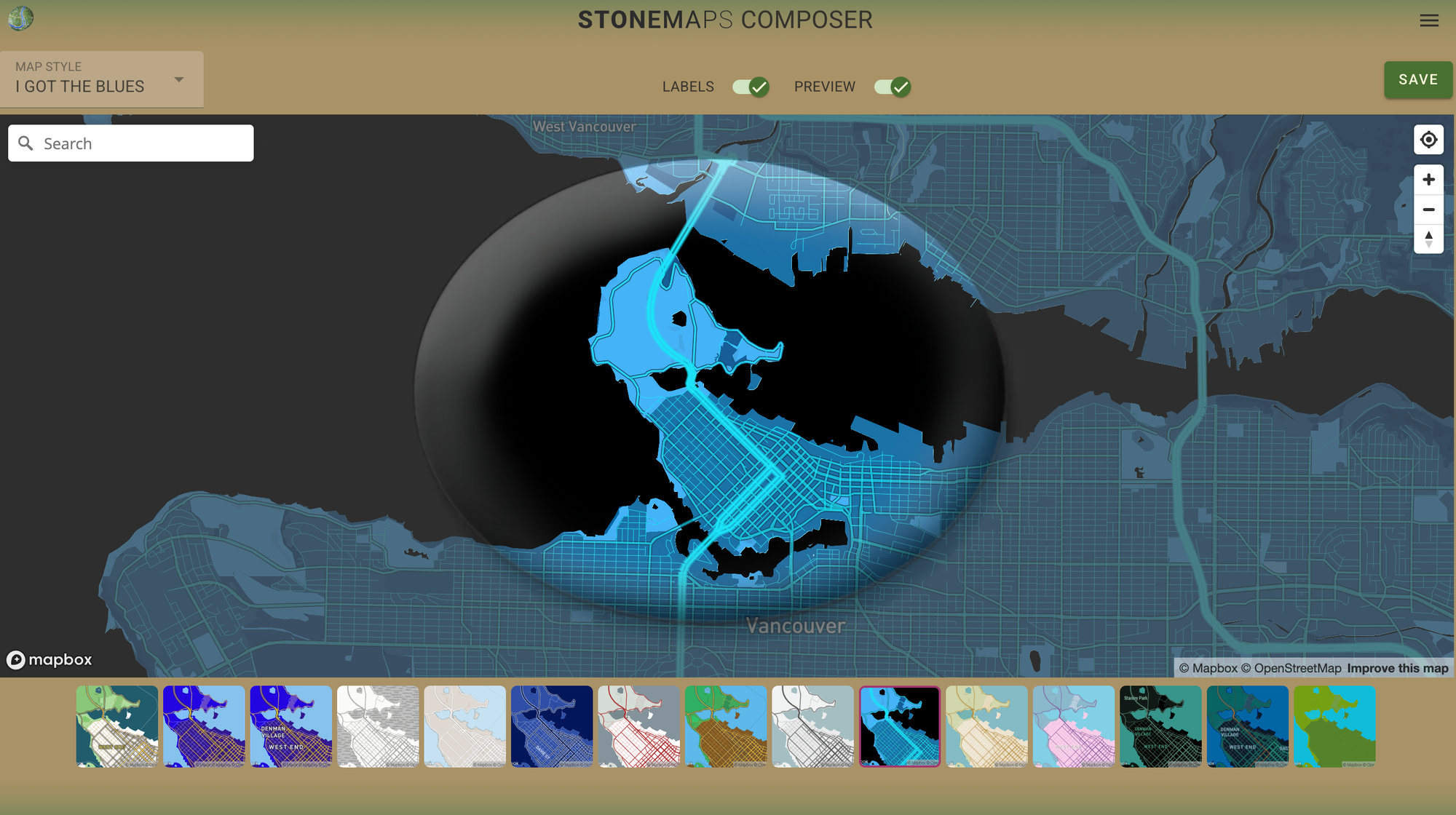
Composer is built using Mapbox API and custom maps; it is fully functional, and S3 participants are invited to compose their own stones for the next prototyping round. The Composer is not required for the 50-stone pilot, since we will be using our existing prototypes.
The Ask (studio context)
The smallest version of this project that genuinely matters looks like this:
50 stones in circulation.
In people’s hands.
In use.
From the first prototyping run, there are approximately 80 stones. The intention is to launch an initial set of 50, each paired with:
- a functioning Planetary Emissary with memory
- a complete but minimal mobile interface
- a place for reflection, journaling, and feedback
These stones will be gifted to members of the AI workgroup, S3 participants, and a small number of invited collaborators.
From there, we pay attention as the stones do their work. They are held, lived with, written with, and passed on.
What’s needed now is a concerted effort to complete the last mile, so our first living pilot can exist in the world.
Where collaboration is most useful
Support and collaboration are welcome across several overlapping areas:
- Language & framing — what is this?
- Conversational AI — evolving the PE
- Platform & infrastructure — build the backend
- Mobile UI/UX — the mobile experience
Participation can be light or deep. Observation is a valid form of engagement.
Details
Technical Stack (Current):
Frontend: Progressive Web App (PWA) - Svelte/SvelteKit, mobile-first
Backend: Python, needs database architecture decisions
AI: OpenAI API → custom PE logic layer
Tools: Stonemaps Composer (Mapbox), hydrographic printing + NFC
Proposed Timeline:
Now - February: Build MVP software, prototype stones (50)
March: Test with prototype stones
April: Refine based on feedback, prepare Kickstarter campaign
May/June: Kickstarter launch
Next Steps
Wednesday's AI Workgroup Session: Presenting the project, showing the Composer, demoing the PE concept, and discussing development challenges. We can talk about what help is needed and how people might want to contribute.
Session 0: If there's interest from Wednesday's AI Workgroup Session, we'll formalize an agenda for an ongoing series of Studio Sessions (S3) and start building together. First session probably in ~2 weeks.
Prototype stones: When they arrive (end of January), we'll distribute them to S3 participants so everyone can test with real objects in real hands. A stone in hand is worth two in the bush.
Discord: We can set up a Discord or Slack channel
What We're Working On
Near-term focus (next 6-8 sessions):
- PE Conversation Design
What should the Planetary Emissary actually say when you first scan a stone? How does it invite engagement without being pushy? What makes a conversation feel meaningful rather than transactional? - Technical Problem-Solving
PWA refinement, PE integration, Memory, Composer improvements, production workflow optimization—whatever technical challenges emerge. - Real-World Testing
Prototype stones in participants' hands. What works? What's confusing? What needs refinement? How does it feel to actually use this thing? - Community & Momentum Building
How do we build pre-launch interest? What content prepares people to understand what we're offering? Who are our early adopters? - Kickstarter Campaign Preparation
How do we explain Stonemaps clearly and compellingly? What messaging resonates? What visuals tell the story? How do we position this as a cultural introduction rather than a product launch?
Our trajectory:
Start informal and experimental → sharpen through iteration → build momentum and materials → learn from real response → launch Kickstarter when ready → continue evolving.
Project Resources
Links:
Try the Composer:
We've built a tool where you can compose your stonemap with customized maps of any location on the planet. Zoom to street level, choose map styles, and preview your own stone (click preview)
Read: Stonemaps: A Slow Intentional Network for Collective Sentience
Research Paper presented at ISEA 2020: Foundational research for Stonemaps: Strong bonds and weak ties; Gifting and Reciprocity; Intentional Networks; Slow Media; Sharing Economy; Collaboration; Co-Creation; Dialogue; Physical Interfaces; The Commons.
Find out More about Stonemaps:
The story, philosophy, and project background. A website in support of our previous funding applications.
Downloads:
FAQ
Questions you might have:
What's the business model and timeline?
First Edition Kickstarter (May 2025 target): 1,500-2,500 stones at $50 base tier ($85 with lifetime AI access). Goal: $25K to fund software completion, production scaling, and fulfillment. I'm matching with $10K in equipment and labor already invested. Revenue model: Base tier includes 3 years AI access; after that, optional $35/year subscription to continue conversations (stone and map are yours forever regardless). Lifetime tier helps build operational endowment for long-term sustainability. Beyond First Edition: Future editions explore new features (traveling stones, stone-to-stone pairing), new map styles, institutional partnerships, and expanded capabilities based on what we learn from real users.Why stones? Why not just an app?
The physical object is primary. It's tactile, beautiful, permanent—it grounds the digital experience in something real you can hold. The stone matters as much as the technology. This inversion (object first, tech serves object) is core to the anti-platform philosophy. Plus, honestly: apps get deleted. A beautiful stone sits on your desk for years. It changes the relationship entirely.What's the production capacity and how does fulfillment work?
Current capacity: Working with CDMX fabricator, validated workflow can produce 1,000-2,000 stones/month. Hydrographic printing process is proven, NFC embedding is straightforward, QR codes are backup. Fulfillment: Professional logistics broker handles international shipping. Backer pays shipping (standard for Kickstarter). Composer access given immediately upon campaign success; physical stones ship in rolling fulfillment over 2-3 months post-campaign. Quality control: I oversee production directly, multiple inspection stages, replacement protocols for any issues.How do you prevent this from becoming just another social media platform?
By design: no feeds, no followers, no algorithmic optimization, no ads, no data harvesting. Stones are the nodes, not people. Connections form through physical proximity and intentional gifting, not friend requests. Optional public sharing is anonymous and location-general only. The architecture prevents platform mechanics from emerging.What's the market? Who actually wants this?
Core audience: People disenchanted with mainstream social platforms who value: mindful technology, place-based awareness, beautiful objects with meaning, thoughtful AI interaction, gift economy values, planetary consciousness. Overlapping communities: Artists and designers, educators, environmentally-minded folks, collectors of meaningful objects, people interested in contemplative practice, early adopters of alternative tech. Scale expectation: This is intentionally small-scale to start. First Edition validates the model; if it resonates, future editions scale thoughtfully without compromising values.What happens if the Kickstarter doesn't fund?
Honest answer: I'll regroup and try again with better messaging, or pursue alternative paths (institutional partnerships, direct sales to smaller community). The production infrastructure exists either way. But failure would be valuable learning—maybe this is too weird, maybe the timing's wrong, maybe the explanation isn't clear enough. We'd figure it out.How customizable are the maps?
Very. The Stonemaps Composer lets you choose any location on Earth, zoom from continent-level to individual-building level, select from multiple cartographic styles, toggle labels and features, and preview on stone overlay before committing. First Edition uses pearl white stones with single map style for production reliability, but future editions will explore more styles and materials.What if I can only help with one specific thing in S3?
Perfect. Even focused contribution on a single aspect (database design, PE conversation refinement, campaign messaging, user testing) is valuable. You don't need to be involved in everything. The commitment is genuine interest and willingness to help where your expertise is relevant, not rigid attendance at every session.Can I try the Planetary Emissary before committing to help?
Yes—I can share the CustomGPT demo link so you can experience actual conversations. It's functional but rough, which is part of what S3 will refine. Testing it yourself will give you a much better sense of what we're building.What about data privacy and AI ethics?
Full privacy: Your conversations and journal are yours—no sharing, no selling, no exposure
Anonymized learning: We derive insights for project improvement, but data is aggregated and non-identifiable
Relational AI ethics: PE designed with respect for human agency, honest about AI nature, aware of power dynamics
Contemplative, not extractive: This is technology for reflection, not surveillance or optimization
The Planetary Emissary framework explicitly addresses AI ethics concerns: it doesn't pretend to be human, doesn't optimize for engagement, doesn't manipulate toward outcomes. It's built to support genuine exploration, not extract value from your attention.
Why All This Matters
Our technology fragments our attention and abstracts us even further from our common physical reality. Human to Human. Human to Planet. Social platforms optimize for engagement, extract attention, and leave us empty.
Stonemaps proposes something different: technology that grounds rather than abstracts, that opens rather than closes, that asks questions rather than gives answers. It's an attempt to build tools that serve human flourishing and ecological awareness rather than extracting value from both, and implementing AI as a cultural technology.
This project has been years in development because these alternatives take time to get right, and time for things to mature. It might work, it might not work. It might be too weird, too niche, too small-scale to matter. It might be big. We think it's worth pushing for as a fundamentally different approach.
If you think so too, let's build it together!
— Hanif (on behalf of all the Stonemaps collaborators, past, present and future)
Questions? Reach out:
Email: hanif.janmohamed@gmail.com
Phone/WhatsApp: 1 604 802 7154